
Slim Bettaieb

Cryptographer  ·  Technology Innovation Institute

I am a cryptographer working on the design and analysis of post-quantum cryptographic schemes, as well as on secure and efficient cryptographic implementations.

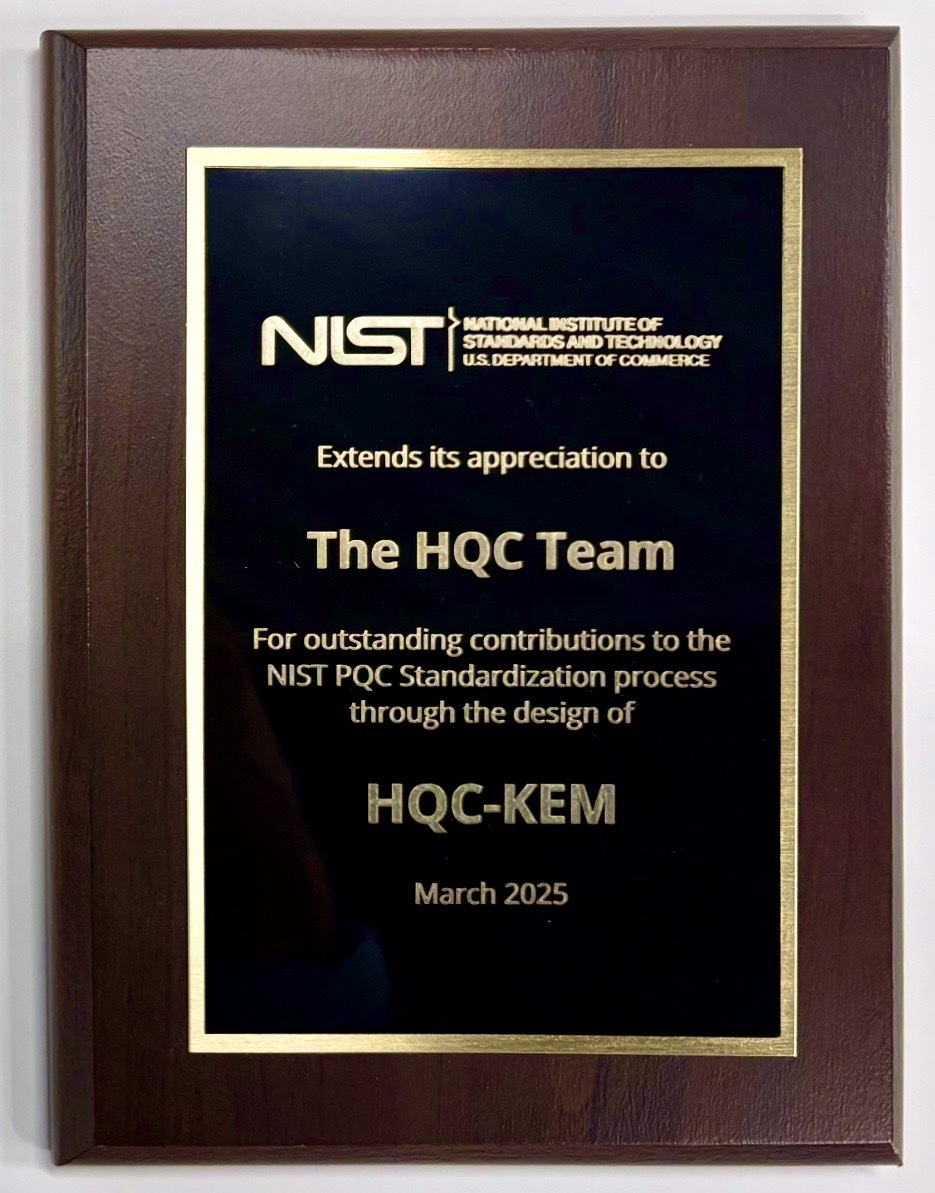
I have contributed to NIST's post-quantum cryptography standardisation process and am one of the co-authors of HQC-KEM, a code-based key encapsulation mechanism selected by NIST for standardisation in March 2025; see the Standards section. I am currently a cryptographer at the Technology Innovation Institute (TII) in Abu Dhabi. Before joining TII, I worked as an applied cryptographer at Worldline's R&D labs.

My research interests lie in applied post-quantum cryptography and its impact on real-world applications, secure implementation of cryptographic primitives, and privacy-preserving primitives.

Applied Post-Quantum Cryptography Real-World Applications Secure Implementation Privacy-Preserving Primitives

Standards

🏛 NIST Standard Co-Author Implementation Maintainer

HQC-KEM

Hamming Quasi-Cyclic — Key Encapsulation Mechanism

HQC (Hamming Quasi-Cyclic) is a code-based Key Encapsulation Mechanism selected by NIST for post-quantum cryptography standardisation. It is built on the hardness of decoding quasi-cyclic codes in the Hamming metric. I am one of the co-authors of HQC and one of the maintainers of its official implementations.

Beyond HQC, I have also been involved as a co-author in several other submissions to the NIST post-quantum cryptography standardisation process, spanning both the main KEM competition and the ongoing additional signatures on-ramp.

SDitH
Digital Signature Scheme
3rd Round · Ongoing

Syndrome-Decoding-in-the-Head (SDitH): a VOLE-in-the-Head / Threshold-Computation-in-the-Head signature scheme based on the syndrome decoding problem. It was recently selected for the third round of NIST's additional post-quantum digital signatures standardization process.

PERK
Digital Signature Scheme
2nd Round Candidate

PERK is a digital signature scheme based on the hardness of solving the PERmuted Kernel problem. Submitted to the NIST on-ramp; not advanced to the third round.

NIST PQC KEM Competition
BIKE
Key Encapsulation Mechanism
4th Round Candidate

Bit Flipping Key Encapsulation: a code-based KEM based on quasi-cyclic moderate density parity check (QC-MDPC) codes. Reached the fourth round of the NIST PQC competition.

RQC
Key Encapsulation Mechanism
2nd Round Candidate

Rank Quasi-Cyclic: a KEM based on the hardness of decoding quasi-cyclic codes in the rank metric. Submitted to the NIST PQC competition and reached the second round.

ROLLO
Key Encapsulation Mechanism
2nd Round Candidate

Ouroboros-R, LAKE and LOCKER: a family of rank-based cryptographic KEMs submitted to the NIST PQC competition and reached the second round.

Publications

Contact

I am always happy to discuss research or potential collaborations. Feel free to reach out through any of the channels below.





















